Who Caused the Mess? Piyush Goyal’s Berlin Challenge and India’s Clean Energy Record
Clean Energy
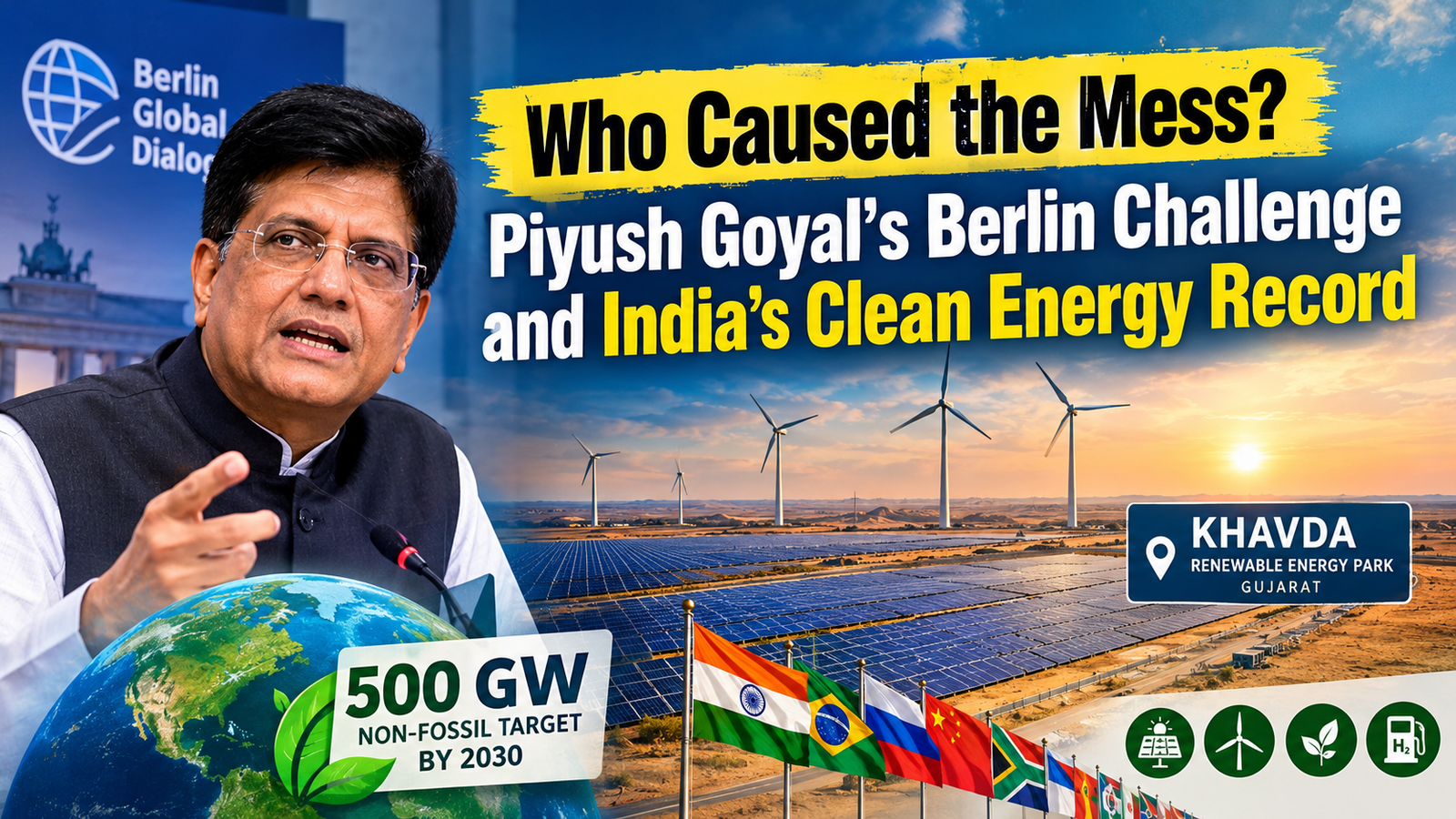
At the Berlin Global Dialogue, Union Commerce and Industry Minister Piyush Goyal sat with Western patrons of the climate agenda and clean energy transition and asked the question they rarely hear on their own platforms: “Who’s responsible for this mess in the first place? Where did the ozone layer get damaged? Who sent all that carbon into the atmosphere?”
He then dismantled the narrative with simple arithmetic. “I represent 17% of the world’s population, but my contribution to carbon emissions is less than 3%,” he said. Europe, with “probably 3% or 4%” of the population, carries a contribution that is “humongous.” His verdict was blunt: “The problem was caused by you.”
Such words can be spoken on a global stage only when a country’s record stands behind them. India’s does, and nowhere more visibly than in the arid expanse of Kutch in Gujarat, home to one of the country’s most ambitious renewable energy projects.
The Confidence Behind the Words: India’s Renewable Energy Record
The most visible symbol of India’s clean energy push is Khavda in Gujarat, the world’s largest renewable energy park. Spread across 538 square kilometres, nearly five times the size of Paris, it combines solar, wind and hybrid technology at a scale never attempted before. Prime Minister Narendra Modi laid the foundation stone in December 2020. Planned for 30 GW by 2029, it already had 10.752 GW operational in the first half of FY2026–27, up from the first gigawatt commissioned in 2024. At full capacity, it is expected to generate 87.4 billion units of clean electricity a year and power around 17.4 million homes.
But Khavda is only the flagship. India’s confidence rests on a wider set of renewable energy policies that have already delivered results. The country has rapidly expanded its overall solar and wind capacity, making non-fossil sources a growing share of the electricity mix and moving steadily towards the 500 GW non-fossil energy target for 2030.
The National Green Hydrogen Mission is creating a new clean-fuel pathway for industry and transport. Ethanol blending in petrol has risen sharply, cutting both emissions and oil imports. The UJALA LED programme has replaced hundreds of millions of inefficient bulbs, delivering large energy savings at the household level. Railway electrification has accelerated, reducing diesel use on one of the world’s largest rail networks. Schemes such as PM-KUSUM have taken solar power to farms, while the push for electric vehicles and battery storage is beginning to reshape urban mobility and grid stability.
These measures are deliberate. They pair daytime solar with night-time wind, add storage to manage intermittency, and focus on affordability so that economic growth and decarbonisation can move together. Clear timelines, Centre-state coordination and a stable policy framework have drawn private investment alongside public effort. The result is one of the world’s fastest-growing clean energy programmes, achieved without waiting for the climate finance that developed countries promised.
Climate Finance and India’s Clean Energy Progress: Delivering While Others Promise
Piyush Goyal’s second charge was about money. Recalling the Paris conference, he said developed countries, “who have enjoyed the fruits of messing up the climate for so many decades,” agreed to support developing nations with “just $100 billion a year.” His assessment of the follow-through: “Eleven years later, we haven’t seen a nickel or a dime of that. It’s all promises.”
India did not wait. “Even today, Europe’s per capita contribution to carbon emissions is probably seven or eight times that of India,” Goyal noted. India must meet “the needs of 1.4 billion people,” including their energy and food needs, and still runs “one of the world’s fastest-growing clean energy programmes.”
Khavda is that programme in concrete form. Every unit generated there reduces dependence on imported coal and gas and cushions the economy against fuel-price shocks. At full capacity, it will cut tens of millions of tonnes of carbon dioxide each year while supporting industry. It also creates green jobs, and the roads, water systems, optical fibre and transmission corridors built for it will serve Kutch long after construction ends.
Critics point to transmission readiness and difficult terrain. The government’s answer has been to speed up supporting infrastructure and storage, keeping the 2029 target on track while power already flows to the grid.