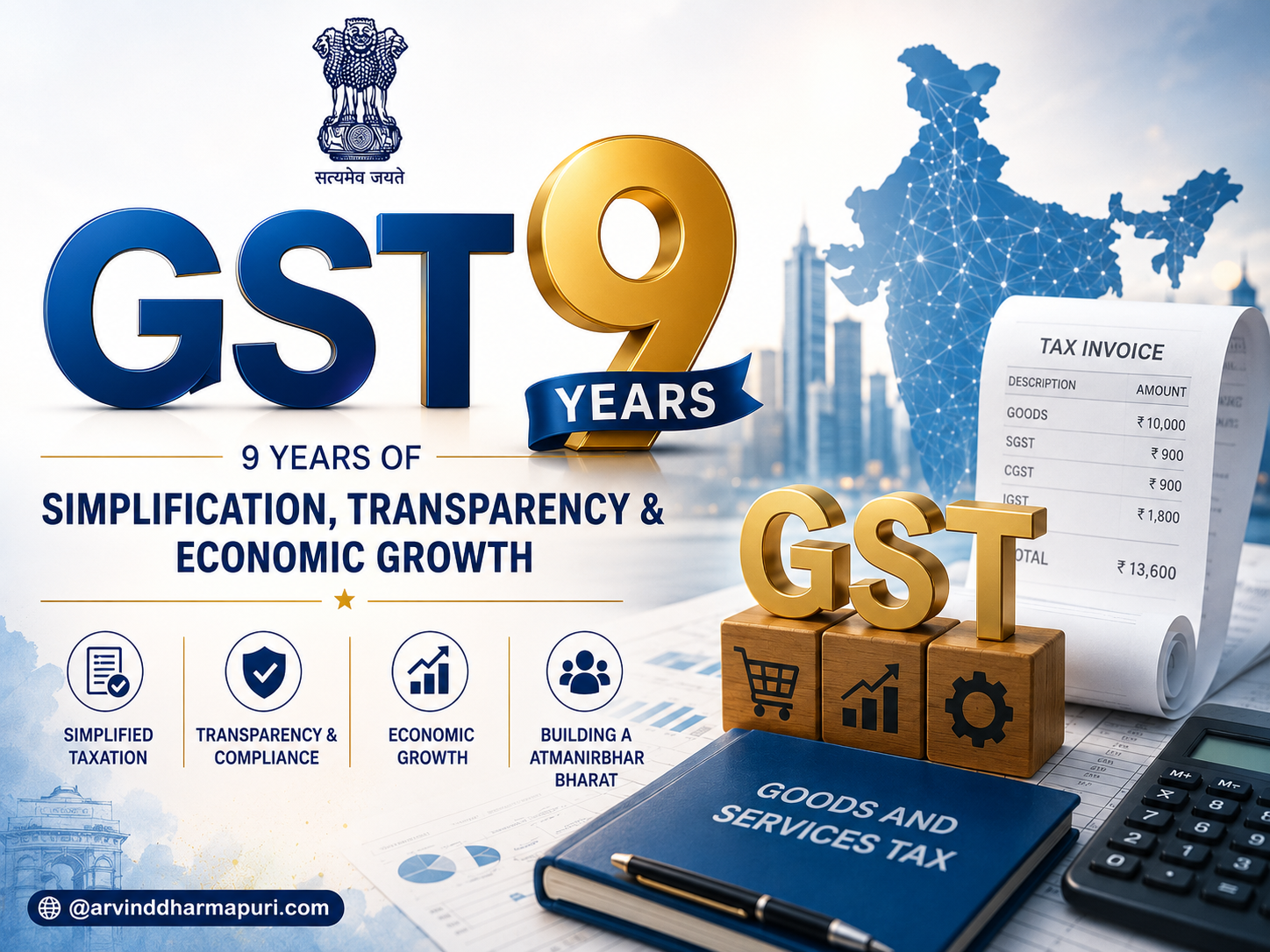
Nine Years of GST: The Modi Government Reform That Reshaped India’s Economy
On July 1, 2017, India embarked on one of the most ambitious economic reforms in its history. The Goods and Services Tax (GST) replaced a maze of indirect taxes with one unified system, creating the foundation for a stronger, more transparent, and integrated national market. Nine years later, GST stands as a defining achievement of Prime Minister Narendra Modi’s government’s reform agenda. It has transformed tax administration, expanded the taxpayer base, strengthened cooperative federalism, and boosted government revenues.
From a Fragmented Market to ‘One Nation, One Tax’
Before GST, businesses navigated multiple central and state taxes such as excise duty, service tax, VAT, octroi, entry tax, and purchase tax. Every state followed different rules, raising compliance costs and delaying the movement of goods.
The Modi government changed this landscape by introducing GST under the vision of “One Nation, One Tax, One Market.” The reform removed cascading taxes, simplified compliance, and enabled seamless movement of goods across state borders. Interstate logistics improved significantly as check posts disappeared, reducing transport time and fuel costs while making Indian businesses more competitive.
GST also strengthened India’s internal market by allowing companies to optimise supply chains based on business efficiency rather than tax considerations.
GST Revenue Growth: A Stronger Economy Backed by Higher Collections
The greatest proof of GST’s success lies in its revenue performance. Monthly GST collections have steadily climbed over the years, reflecting stronger economic activity, better compliance, and widespread digitisation.
Let’s look at the numbers:
- Average monthly GST collection has nearly doubled from around ₹90,000 crore in 2017-18 to well above ₹1.8 lakh crore in 2025-26.
- India recorded an all-time high monthly GST collection of ₹2.37 lakh crore in April 2025.
- Gross GST collections crossed ₹22 lakh crore during FY 2025-26, setting another national record.
These numbers demonstrate that lower tax evasion and improved compliance have created a stronger and more stable revenue base for both the Centre and the states.
Technology and Digital Governance: GST’s Biggest Strength
The Modi government built GST as a fully digital tax system. Registration, return filing, tax payment, invoice matching, and refunds now happen online through a transparent technology platform.
The introduction of e-invoicing, e-way bills, and advanced data analytics has significantly reduced tax leakage. Artificial intelligence and data-driven monitoring have helped authorities identify fake invoices and fraudulent input tax credit claims.
GST has also made compliance easier for honest taxpayers while improving enforcement against tax evasion.
GST and the Formalisation of India’s Economy
GST has encouraged businesses to enter the formal economy. Since businesses can claim input tax credit only through proper invoices, companies increasingly transact through formal channels.
The taxpayer base has expanded remarkably:
- Registered GST taxpayers have increased from around 65 lakh at launch to more than 1.5 crore today.
- Millions of small and medium enterprises have joined the formal tax ecosystem.
- Digital payments and formal invoicing have gained widespread acceptance.
Greater formalisation has improved access to institutional finance, strengthened transparency, and enhanced investor confidence.
Cooperative Federalism Through the GST Council
GST represents one of India’s strongest examples of cooperative federalism. The GST Council, comprising the Union Finance Minister and state finance ministers, makes decisions through consensus rather than confrontation.
Since its inception, the Council has continuously simplified tax rates, rationalised procedures, and addressed industry concerns. This collaborative approach has ensured policy stability while protecting the fiscal interests of both the Centre and the states.
The Centre also honoured its commitment to compensate states during the challenging pandemic years, reinforcing trust in the new tax framework.
GST and Ease of Doing Business in India
GST has reduced paperwork, simplified interstate trade, and lowered logistics costs. Businesses no longer maintain separate tax systems for different states.
Manufacturers, exporters, startups, MSMEs, and logistics companies have all benefited from simplified taxation and faster movement of goods. Faster refund processing has also improved cash flows, particularly for exporters competing in global markets.
These improvements have strengthened India’s position as an attractive destination for manufacturing and investment under initiatives such as Make in India and Atmanirbhar Bharat.
What Lies Ahead for GST?
Like every major reform, GST faced initial implementation challenges. The Modi government responded by reducing compliance burdens, simplifying return filing, rationalising tax rates, and leveraging technology to make the system more efficient. Continuous reforms have strengthened taxpayer confidence and improved ease of compliance.
As India moves toward becoming a developed nation by 2047, GST will remain a critical pillar of economic transformation. By creating a unified national market, improving tax compliance, boosting revenues, and accelerating formalisation, GST has reshaped the way India does business.
Nine years after its launch, GST has evolved from a landmark tax reform into a powerful engine of economic growth. It reflects the Modi government’s commitment to transparency, digital governance, and structural reforms that strengthen India’s long-term development. As the country advances toward a $5 trillion economy and beyond, GST continues to provide the fiscal foundation for faster, cleaner, and more inclusive growth.