A picture that says a lot about India’s Policy and its global south leadership
Brics Summit
There are moments at an international summit that go beyond the formal speeches and carefully drafted declarations. One such moment came during the 18th BRICS Summit in New Delhi, when Prime Minister Narendra Modi was seen walking alongside Iranian President Masoud Pezeshkian. The image, captured at Bharat Mandapam, was not merely a moment of cordiality between two leaders. It reflected the larger character of Indian diplomacy: engagement without isolation, dialogue without surrendering national interests, and friendship without allowing geopolitical rivalries to dictate India’s choices. The meeting took place at a particularly sensitive time for West Asia, making the symbolism of the encounter even more significant.
The 18th BRICS Summit in New Delhi
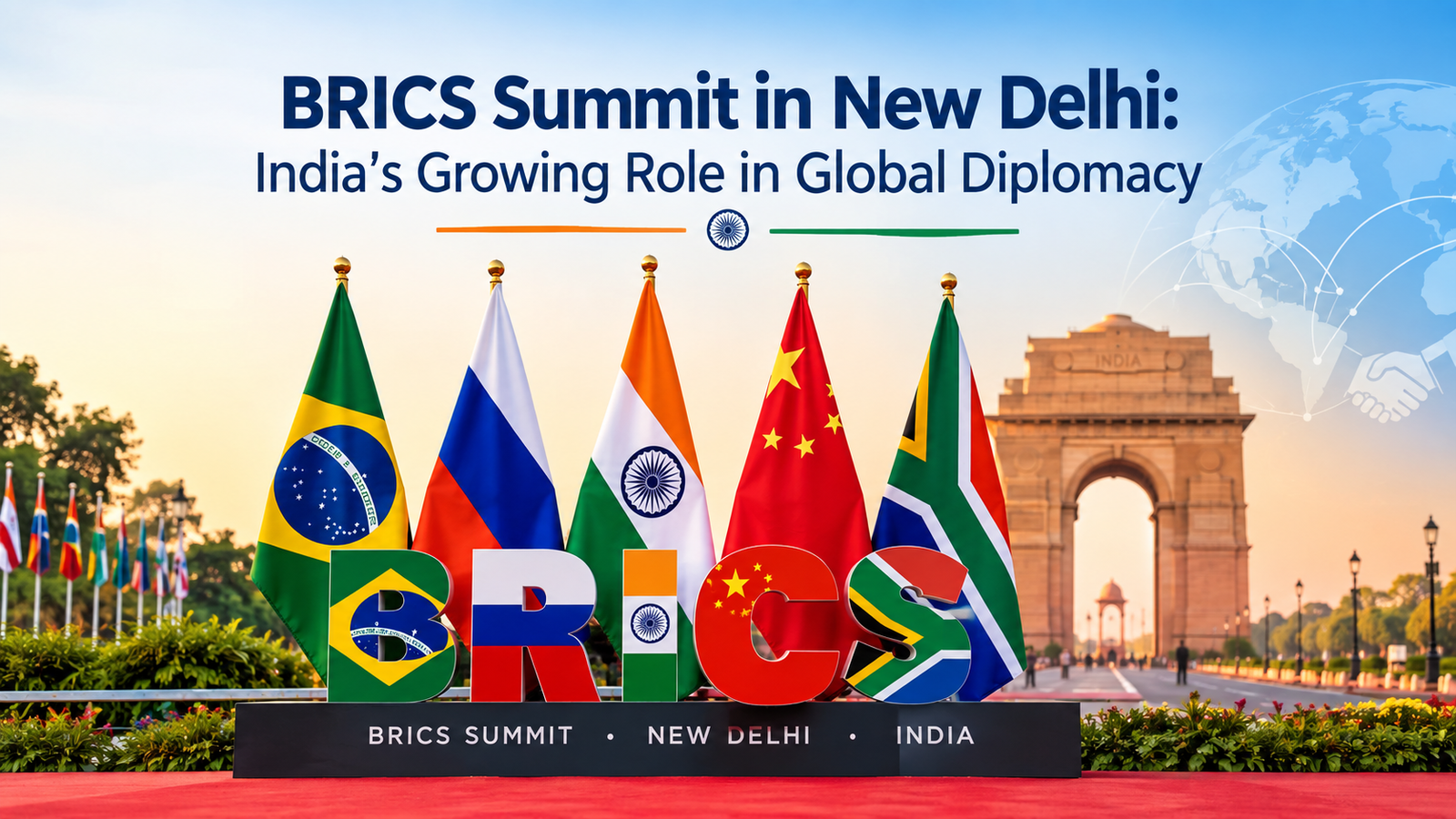
The 18th BRICS Summit itself provided a larger backdrop to this message. India hosted leaders of the expanded BRICS grouping in New Delhi under the theme of resilience, innovation, cooperation and sustainability. The New Delhi Declaration placed considerable emphasis on a fairer and more representative international order, inclusive growth, stronger economic cooperation and a greater voice for developing countries.
This is where India’s role becomes important. For decades, much of the Global South was expected to adjust to decisions taken elsewhere. The emerging Indian approach is different. New Delhi increasingly argues that developing nations should not merely be rule-takers but should have a meaningful role in shaping the rules of the global system. Prime Minister Modi articulated this idea at the summit by calling for the Global South to move from being “rule-takers” to “rule-shapers.”
India’s economic weight gives this diplomatic message greater substance. The world’s economic centre of gravity is changing and emerging economies are playing a larger role in global trade, investment, technology, energy and supply chains. India’s own growth story is increasingly intertwined with the prospects of the wider developing world. Therefore, when India speaks about resilient supply chains, technology, energy security, financial cooperation or reform of global institutions, it is not speaking only for itself. These are issues that directly affect countries across Asia, Africa and Latin America.
BRICS and India’s Vision for the Global South
The BRICS discussions on energy are a good example. The New Delhi Declaration called for an energy transition that is just, orderly, equitable and inclusive while recognising the continuing importance of conventional energy sources for emerging and developing economies. It also highlighted energy security, resilient infrastructure, critical minerals and cooperation in the digitalisation of energy systems. This is a significant approach for the Global South, where economic development and energy security cannot simply be separated from climate ambitions.
The same principle is visible in India’s relationship with Iran. Iran matters to India not because New Delhi wants to become part of any regional camp, but because geography and national interest make the relationship important. Iran provides India with a strategic connection towards Afghanistan and Central Asia, while the development of Chabahar Port remains relevant to India’s connectivity ambitions. Energy security, regional stability, trade routes and the safety of maritime commerce all make Iran an important part of India’s broader West Asia and Eurasia policy.
That is why the Modi-Pezeshkian meeting deserves to be viewed in the wider context of Indian diplomacy. India has strategic relationships with the United States and Europe, longstanding ties with Russia, important engagement with the Gulf countries and a continuing relationship with Iran. These relationships are not mutually exclusive in the Indian strategic framework. New Delhi has increasingly demonstrated that it will engage with different powers according to India’s own interests rather than allowing external rivalries to determine the boundaries of Indian foreign policy.
BRICS and Global Economic Cooperation
The situation in West Asia makes this approach even more relevant. At his meeting with President Pezeshkian, Prime Minister Modi reiterated India’s position that outstanding issues should be addressed through dialogue and diplomacy. He also stressed the importance of peace and stability, freedom of navigation and commerce, and the safety of seafarers. These concerns are not abstract diplomatic principles for India. Instability in West Asia can affect energy supplies, shipping routes, global trade and millions of people whose livelihoods are connected to the region.
There was another important diplomatic outcome at the New Delhi summit: the BRICS Declaration specifically condemned the Pahalgam terror attack. The declaration described the attack as criminal and unjustifiable. For India, the significance was not simply the wording but the fact that the issue found space in a multilateral declaration involving the expanded BRICS grouping.
Jammu and Kashmir Chief Minister Omar Abdullah also highlighted this point. He said that the fact that Pahalgam itself was mentioned by name was significant, particularly given the presence of countries that maintain close relations with Pakistan. He described the inclusion of Pahalgam as an achievement of India’s foreign policy, while also saying that the question of why Pakistan was not directly named should be addressed by the Government of India and the Ministry of External Affairs. His comments are noteworthy because they underline that the diplomatic significance of the declaration can be recognised even while political differences remain over its exact wording.
Energy Security at the BRICS Summit
This is perhaps one of the clearest messages from the New Delhi BRICS Summit: India is trying to build influence without turning influence into confrontation. The presence of leaders from countries with sharply different relationships with one another—including China, Russia, Iran and other major emerging economies—created a complicated diplomatic environment. Yet India managed to bring these countries together around a common declaration that addressed terrorism, economic cooperation, energy, global governance and international stability.
The image of Modi and Pezeshkian therefore has a meaning beyond India-Iran relations. It represents an India that is confident enough to speak to different sides of a divided world. It represents a foreign policy in which dialogue is not seen as weakness and engagement is not confused with alignment. India can disagree with a country on one issue while cooperating with it on another, because the central reference point remains India’s national interest.
There is also an economic dimension to this diplomacy. India’s rise is no longer being discussed only in terms of its domestic market. Its expanding economy, digital capabilities, infrastructure, manufacturing ambitions, technology sector and growing role in global supply chains increasingly affect the wider international economy. A stronger Indian economy gives India greater capacity to contribute to global growth while also giving developing countries an important partner in discussions on technology, finance, infrastructure and development.
This is ultimately what makes India’s leadership of BRICS significant. The objective is not to create another rigid bloc against an existing bloc. It is to ensure that the changing economic realities of the world are reflected in the institutions that govern the global system. The New Delhi Declaration’s emphasis on a more representative international order, inclusive growth and stronger participation of developing countries fits into that larger argument.
What the BRICS Summit Means for India
The photograph of Modi walking with Pezeshkian captures that philosophy in a single frame. At a time when global politics is increasingly defined by camps and confrontation, India is signalling that it intends to maintain relationships across those divides while pursuing its own strategic and economic interests. The real measure of this approach will ultimately be its ability to convert diplomatic engagement into peace, connectivity, economic opportunity and a stronger voice for the developing world. But the BRICS Summit in New Delhi showed that India is prepared to make that case from the centre of the global conversation.