Ops Sindoor to Arunachal: Congress Doubts the Army, the Courts and the Election Commission, but Never Itself
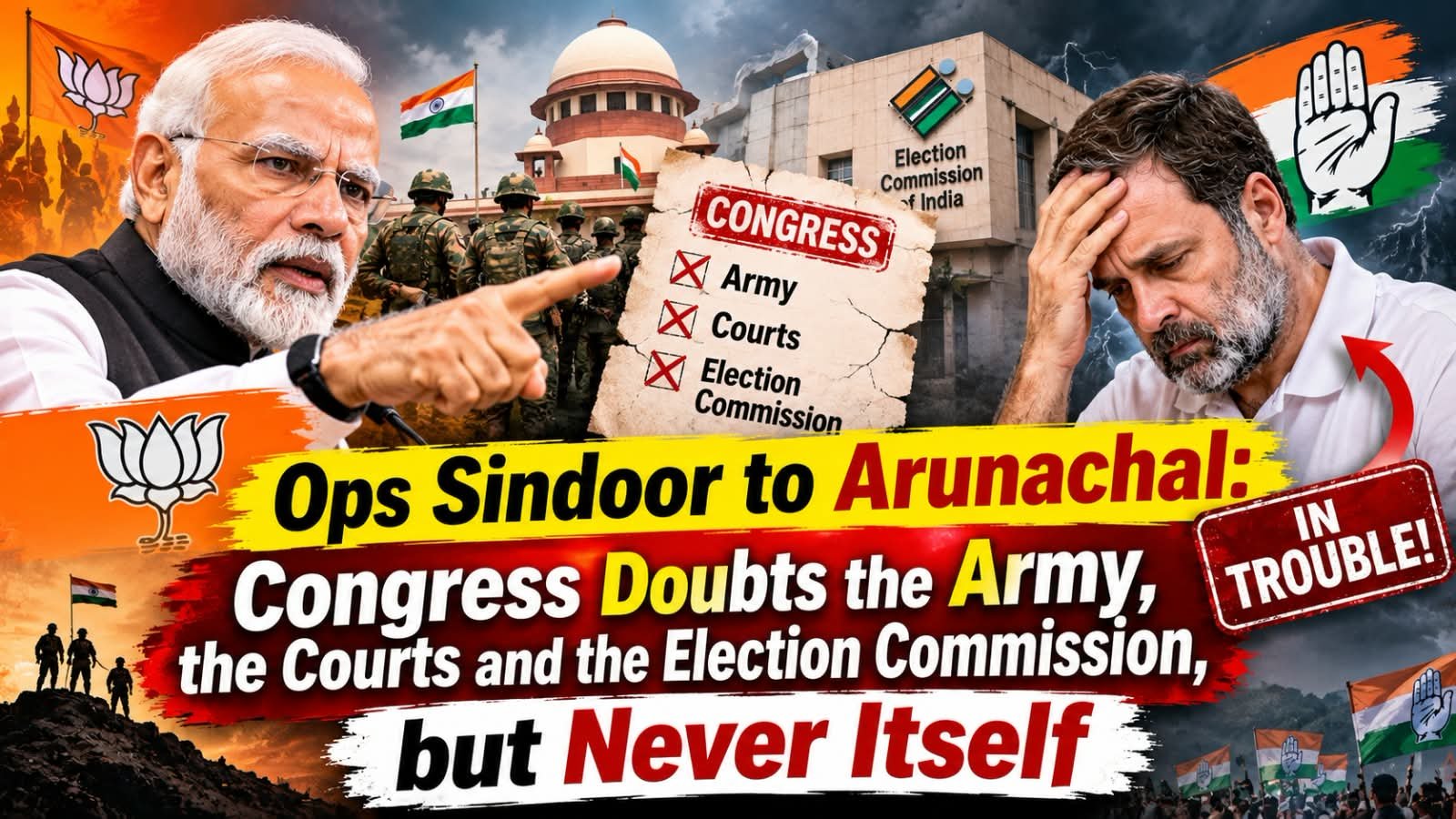
Congress
When India faces a threat from beyond its borders, the battle is never confined to the frontiers. From within, a familiar chorus rises: doubt the Army’s account, question the government’s claims, challenge the nation’s resolve. The soldier’s word is put on trial, the uniform is made to answer to political suspicion, and patriotism itself is dragged into the dock. From Galwan to Sindoor, and now Arunachal, the script barely changes. Only the cast of doubters does not.
Congress Doubts From Surgical Strikes to Sindoor: Questioning the Forces
The pattern predates the current India-China controversy. After the 2016 surgical strikes, Congress leaders, including Digvijaya Singh, demanded proof of an operation the Army had already announced. In 2017, Rahul Gandhi accused the Prime Minister of “dalali” in the blood of soldiers, a remark that turned a military success into a partisan taunt.
Galwan followed the same script. Rahul Gandhi’s “Narendra Surrender” taunt and his repeated claims that China had occupied Indian territory framed the national response as capitulation. In August 2025, the Supreme Court asked him how he knew China had occupied 2,000 sq km of Indian land. A party in the Opposition is entitled to ask questions, but not to assert unverified figures as fact.
Operation Sindoor repeated the same pattern. After India struck terror infrastructure in Pakistan, Rahul Gandhi told Parliament the government had “tied the hands” of the Air Force. He also alleged the PM “surrendered” on Donald Trump’s orders, though the Centre says the ceasefire came through direct military-to-military talks. When Air Chief Marshal A.P. Singh disclosed Pakistani aircraft losses, Congress leaders questioned the timing as a bid to divert attention from “vote chori”. Pressing on aircraft losses, critics say, mirrored Pakistan’s propaganda and demoralised a force in the field.
The latest episode, in Arunachal Pradesh, fits the same template. After Chief Minister Pema Khandu described the border situation as normal, Congress hit out at him and at the BJP’s handling of China. Then came the videos. Clips shared by a Congress leader claimed China had taken control of parts of the state and that Indian troops were being denied supplies. The Army debunked them. It said a video of Lt Gen Girish Kalia, GOC of Spear Corps, was fabricated and that he had made no such statements.
It also said the movement of commercial vehicles on an authorised border trade route was being misrepresented as a Chinese military intrusion. Union Minister Kiren Rijiju demanded an apology, and BJP’s Nalin Kohli accused Congress of spreading misinformation on national security. For critics, this is the pattern at its sharpest: when the Army’s fact-check contradicts the party’s narrative, the narrative is not withdrawn. Its became congress duty to ask every diplomatic move must be framed as national humiliation. The Arunachal videos show the cost: a fake clip travels faster than a fact-check, and the Army is forced to defend itself against its own country’s Opposition.
Beyond the Barracks: The Assault on Institutions
The doubt does not stop at the military. In August 2025, Rahul Gandhi claimed “open and shut” proof, an “atomic bomb”, that the Election Commission was facilitating “vote chori” for the BJP, and warned officials “from top to bottom” they would not be spared. The Commission called the allegations deplorable and asked him to file a formal declaration. When Congress made similar claims about Haryana, EC sources noted that Congress agents had raised no objections on the ground and that only 22 petitions were pending. However, it’s important to note that Congress never questioned results in states it won.
The BJP’s charge is selective outrage: institutions are credible when the verdict suits Congress and compromised when it doesn’t. The Supreme Court’s rebuke over the China remarks, they say, shows the judiciary is not immune either.
This is where danger lies. A republic runs on shared referees: an election body whose count is accepted, courts whose rulings bind, and armed forces whose word is trusted. A party that has governed India for decades knows how fragile that consensus is. Each unproven allegation drains public trust a little more, and a citizen told that every institution is rigged has little reason to respect any outcome. That, the critics argue, is how a political strategy becomes a threat to stability.
In the frame of scrutinising the executive Congress party and its leaders have always potrayed themself anti-Indian. In the shadow of saving territory, the Congress party has always spoken against Indian Interests and boosted the morale of India’s enemies such as Pakistan and China.