When India’s Balance Sheet Gets Stronger, Nizamabad Gets Stronger
GDP Growth
In today’s scenario amid global uncertainties India’s economy and GDP growth have shown strong momentum.. At the same time, country’s foreign exchange reserves have risen to a historically high level. So, these indicators point to an economy that has both momentum at home and a stronger financial cushion against external shocks.
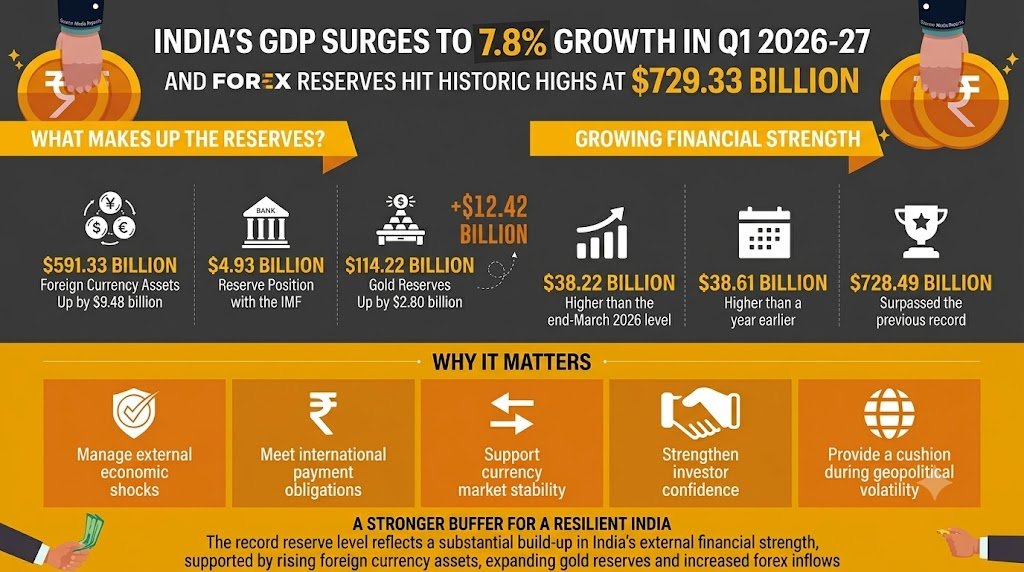
India’s Real GDP growth hits 7.8% in Q1 FY2026–27 while forex reserves reach a record $729.33 billion. Economic strength is meaningful only when it creates confidence beyond the balance sheet, in factory, marketplace, farm and household. So we can say that GDP growth gives India momentum, reserves give that momentum resilience.
What drove India’s 7.8% GDP growth?
For any country’s development we should simply understand the GDP (Gross Domestic Product). GDP growth means that the economy is producing more goods and services and that economic activity is expanding. Higher GDP Growth does not automatically mean that every household becomes richer by same percentage.
For an ordinary household, GDP growth is not about seeing 7% more money in the bank. It can mean in many ways like factories producing more, companies investing more, consumers spending more, banks and financial institutions seeing greater economic activity and governments collecting more revenue that can potentially support infrastructure and public spending.
Let’s look at the key areas to understand how India’s GDP has grown over the years. Services sector grew by 10%, while secondary sector recorded 8.6% growth. Agriculture and allied activities grew by 3.6% and manufacturing saw a strong 9.2% growth. Fixed investment increased by 11.9%, showing higher spending on infrastructure and business expansion. Private consumption grew by 7.1% while exports increased by 12%.
The role of India’s Forex reserves
We have already explained the GDP. Now understand the Forex reserves, what it means for the country. In very simple language strong forex reserves can be considered a shield for the country’s economic security. When dollar demand increases or by any mean rupee comes under pressure due to global crisis, the Reserve Bank of India (RBI) has large foreign exchange reserves to intervene..
Recent foreign exchange inflows have also been instrumental in driving current record reserves. Foreign Currency Assets stand at $591.33 billion while gold reserves are valued at $114.22 billion. The IMF reserve position stands at $4.93 billion in addition to Special Drawing Rights (SDRs). The total reserves stood at $729.33 billion, following an increase of $12.42 billion in one week.
What is the use of $729 billion reserves? They are not those money sitting in a bank account waiting to be distributed to citizens. These reserves act as a financial buffer, helping India manage external pressures such as sudden capital outflows, import-related pressures, currency volatility and geopolitical shocks.
Forex reserves are essentially India’s stockpile of foreign-currency assets and other reserve assets held by the country’s monetary authorities. India needs foreign currency for imports, external payments and other international transactions. When global uncertainty rises or rupee comes under pressure, a larger reserve cushion gives RBI greater capacity to manage external pressures.
But again, a large forex reserve does not directly increase a farmer’s income or guarantee a stronger rupee. Its importance is that it can make the economy better equipped to absorb external shocks. In a simpler way a larger reserve cushion gives the RBI greater room to manage periods of external stress and excessive currency volatility.
Connecting India’s growth to Telangana GSDP
According to data cited by the Telangana government’s Invest Telangana platform, the state’s Gross State Domestic Product (GSDP) grew by 8.5% in 2025–26 at constant prices, compared with 7.4% growth for India’s economy.
The comparison is significant because Telangana is not an isolated economy. Its agriculture, manufacturing, services, technology, pharmaceuticals and export sectors are closely connected to broader Indian economy. Telangana’s official economic data shows that merchandise exports were ₹1.16 lakh crore in 2023-24, with pharmaceuticals alone contributing ₹36,893 crore, or 32%. When India grows faster, it creates stronger domestic demand, encourages investment, improves business confidence and expands opportunities for states that are well integrated into national and global markets.
For Telangana, therefore, India’s economic expansion can act as a multiplier. A growing national economy means a larger market for Telangana’s products and services, greater potential for private investment, stronger infrastructure activity and better opportunities for businesses to connect with global supply chains.
This is where the Centre’s economic and infrastructure policies become relevant to Telangana. Investments in highways, railways, logistics, digital infrastructure, industrial corridors, renewable energy and initiatives aimed at improving manufacturing and exports can strengthen the state’s ability to attract investment and move goods efficiently.
In simple terms, India’s growth creates wider economic momentum, while Telangana’s own strengths determine how effectively the state converts that momentum into jobs, investment, exports and higher incomes.
Nizamabad turmeric exports to global markets
Imagine a turmeric farmer in Nizamabad. He may never follow India’s foreign exchange reserves, GDP growth rate or global currency movements. Yet his livelihood can be connected to all of them through a much larger economic chain. The journey can begin with the farmer and move through a local trader or Farmer Producer Organisation (FPO), a processing unit, packaging and logistics companies, an exporter and finally, an overseas buyer.
Nizamabad’s export-potential assessment identifies turmeric, boiled rice and rice-bran oil among the products with export potential while food processing and turmeric processing have been identified as important opportunities for local industry. In other words, farmer may never receive a single dollar but his product can ultimately earn dollars for India. That is where the connection between India’s macroeconomic strength and Telangana’s local economy becomes clearer.
Government policies can strengthen this connection further. Investments in roads, railways, logistics, digital infrastructure, food processing and export-oriented industries can reduce distance both physical and economic between farmer in Telangana and customer in another country. And in a place like Nizamabad, journey from farm to factory to foreign market shows how global economic strength can eventually find its way back to the local economy.
The Multiplier effect: One export order can support an entire ecosystem
Suppose a turmeric-processing company in Nizamabad secures a large overseas contract. The economic impact does not stop with company that receives order. The company needs turmeric. That creates demand for farmers and farmer-producer organisations. It needs procurement and aggregation. The crop must then be processed, tested, packaged and transported. Warehouses may be required to store product, while banks and insurers support financial and commercial transactions.
A resilient external position for India can further strengthen the environment in which such businesses operate. Greater resilience against external shocks can provide businesses with greater confidence when planning international transactions, sourcing inputs and considering investments.
This does not mean that strong forex reserves automatically create jobs or guarantee export growth. Economic outcomes depend on several factors. But a stronger external position can contribute to a more resilient and predictable macroeconomic environment in which businesses can plan. That is where a national economic statistic begins to acquire meaning at the district level. Investment today creates capacity for tomorrow.
Another important part of India’s economic story is investment. Gross fixed capital formation grew by 11.9% in first quarter, pointing to importance of investment in building productive capacity. Why does this matter? Because investment is not simply about spending money today. It is about creating the infrastructure, technology and productive capacity that can generate economic activity tomorrow.
Telangana already has a strong investment profile, while food processing and agricultural value chains represent significant areas of opportunity. For Nizamabad, this creates an important question. Can district capture more of value created after turmeric leaves farm? That is potentially far more important than simply increasing production.
The National Turmeric Board can form part of this broader ecosystem but larger objective should be to build a value chain in which farmers and local businesses are better positioned to participate in economic opportunities created by rising demand. Nizamabad has an opportunity to move beyond being known primarily as a turmeric-producing region and develop a stronger identity around turmeric processing, value addition, branding and exports.
Why should a farmer, small entrepreneur or family in Nizamabad care? Because external strength of Indian economy contributes to broader environment in which businesses and households operate. The relationship is not automatic or one-to-one. Forex reserves do not directly determine a farmer’s income or guarantee that a particular business will succeed.
The stronger that environment is the greater the possibility of converting economic momentum into sustainable investment and opportunity.
The real measure of economic strength
India’s economic progress should not be judged only by how impressive a number appears on a balance sheet. India’s 7.8% GDP growth gives us momentum. $729 billion in foreign exchange reserves gives us resilience. Investment creates capacity. Exports create global connections and value addition creates local opportunity. That is how India’s macroeconomic strength can begin to translate into a more meaningful economic opportunity at the grassroots.