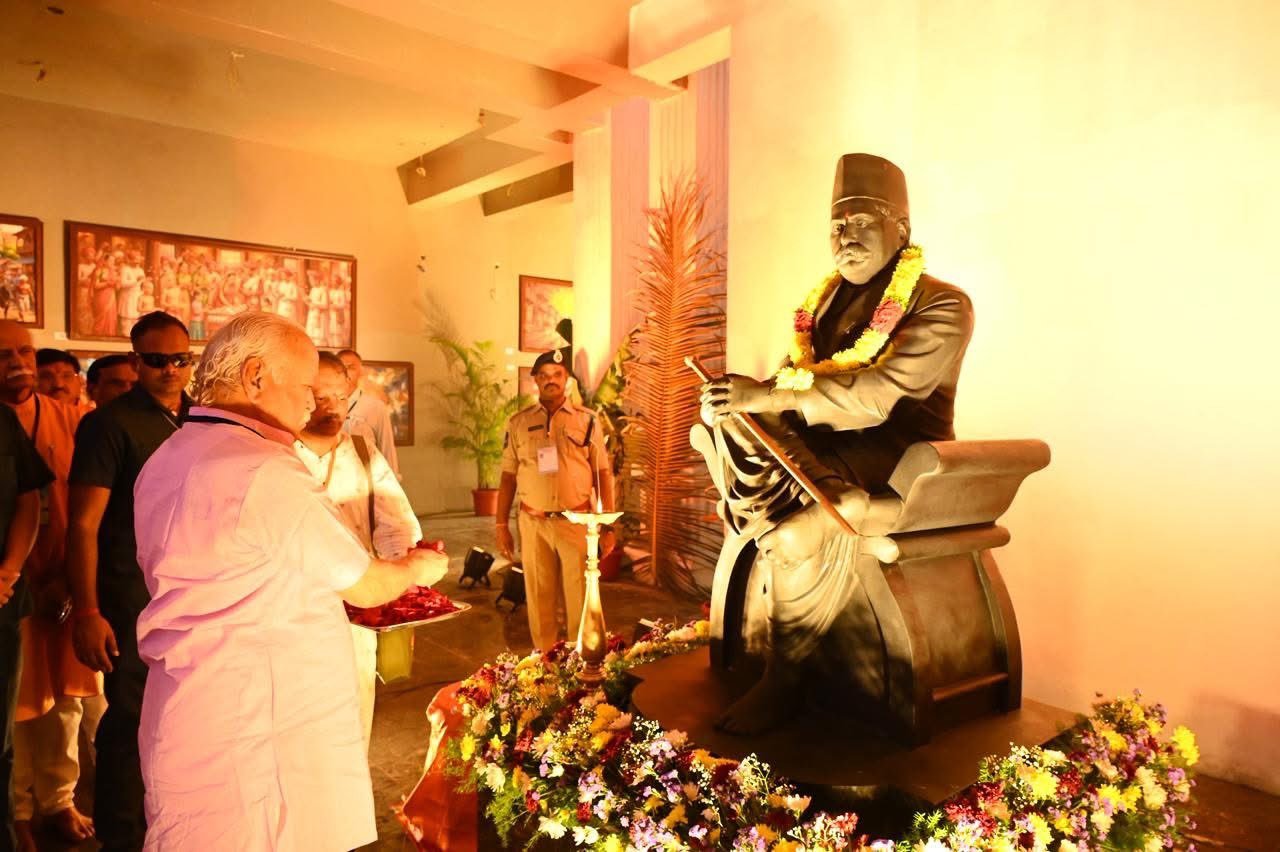
Kandakurthi is a small village in Telangana. Most people outside the state have never heard of it. But on April 11, this ancient village, cradled at the confluence of the Godavari, Manjiraand Haridra rivers, stepped firmly into national consciousness. RSS Sarsanghchalak Dr Mohan Bhagwat inaugurated the Sri Keshav Spoorti Mandir here, a memorial dedicated to Dr Keshav Baliram Hedgewar, the founder of the Rashtriya Swayamsevak Sangh. This is not merely a building. This is a declaration. This is a living reminder of why Guruji started the Sangh in the first place and why that mission remains as urgent today as it was a century ago. The inauguration of this Mandir is one of the most significant cultural moments in recent memory. Not because of its grandeur, but because of the idea it enshrines.
Guruji’s Two Goals Are Still Our Two Goals
When Guruji founded the RSS in 1925, he carried two unwavering goals in his heart. First, he wanted to make Hindus intellectually and ideologically strong, baudhik aur vaicharik roop se majboot. Second, he wanted to unite all Hindus as one people, bound by one puspose of their religion and civilisation. These were not merely goals written on paper. These were the very breath of his life’s work. Look around us today. The threats Guruji identified have not disappeared. They have only changed form and grown more sophisticated. Social division still quietly weakens us from within. Intellectual confusion still leads our youth astray. Identity politics tears at the fabric that holds communities together. Guruji understood with great clarity that no external enemy can truly defeat a people who are united and self-aware. But a people who are divided will hollow themselves out without any enemy needing to raise a hand. The Sri Keshav Spoorti Mandir addresses this challenge directly. The ground floor carries a carefully curated photo gallery of Guruji’s life and struggles. The first floor houses a museum preserving his personal artefacts and handwritten letters. A dedicated video presentation hall will walk every visitor through their ideological journey. This is vaicharik work made permanent in stone and memory. This is precisely what Guruji envisioned, creating spaces where ordinary citizens can reconnect with the depth and strength of their own civilisation.
One Thread, One Nation
Guruji accomplished something that many considered nearly impossible. He took a society fractured by caste, region, language, and the deep wounds of colonial rule and tied it together with a single, unbreakable thread. That thread was Hindu identity. Not as a tool of politics. As an eternal civilisational bond. Kandakurthi itself stands as living proof of this vision. This village sits in Nizamabad, in the heart of Telangana, nearly 380 kilometres from Nagpur, where Guruji built the Sangh from nothing. Yet this soil is his ancestral soil. His roots run deep here, near the sacred confluence of three rivers. His family deity, Keshav Murthy, is worshipped in this very village. The same Guruji who is revered in Maharashtra belongs equally and fully to Telangana. This is the unity Guruji always spoke of, not the transactional unity of political alliances, but the deeper unity of shared heritage, shared faith and shared destiny. When this Mandir opens its doors, swayamsevaks and visitors will arrive from every corner of India. They will come speaking different languages, wearing different clothes, carrying different customs. However, they will all bow before the same man and the same ideal. That single thread still holds, and it always will.
From Smriti to Spoorti: Memory Into Movement
There is profound meaning in the name Sri Keshav Spoorti Mandir and not just Smriti Mandir. Smriti is memory. Sri Keshav Spoorti Mandir is an inspiration. That choice of words was no accident. The organisers are not simply asking us to remember Guruji with folded hands. They are asking us to rise, act and carry his work forward. The Keshav Seva Samithi has already shown what such inspired action looks like on the ground. For three decades, it has run a Shishu Mandir school at nominal fees, building values alongside knowledge. It is now establishing a skill development centre for youth, training women for self-employment and teaching farmers the wisdom of natural farming. This is Guruji’s vision of Hindu unity, not only expressed in speeches, but also lived through seva and empowerment. One more detail deserves mention. Arun Yogiraj of Mysuru sculpted the statues of Guruji and Bharat Mata inside this Mandir, the same hands that shaped the Ram Lalla murti in Ayodhya. That is not a coincidence. It is a continuity. The same spirit that restored Ram’s birthplace now honours the man who wanted every Hindu to stand tall and walk fearlessly. Kandakurthi was always a sacred place. Today, it has become a purposeful one. That is exactly what Guruji would have wanted.