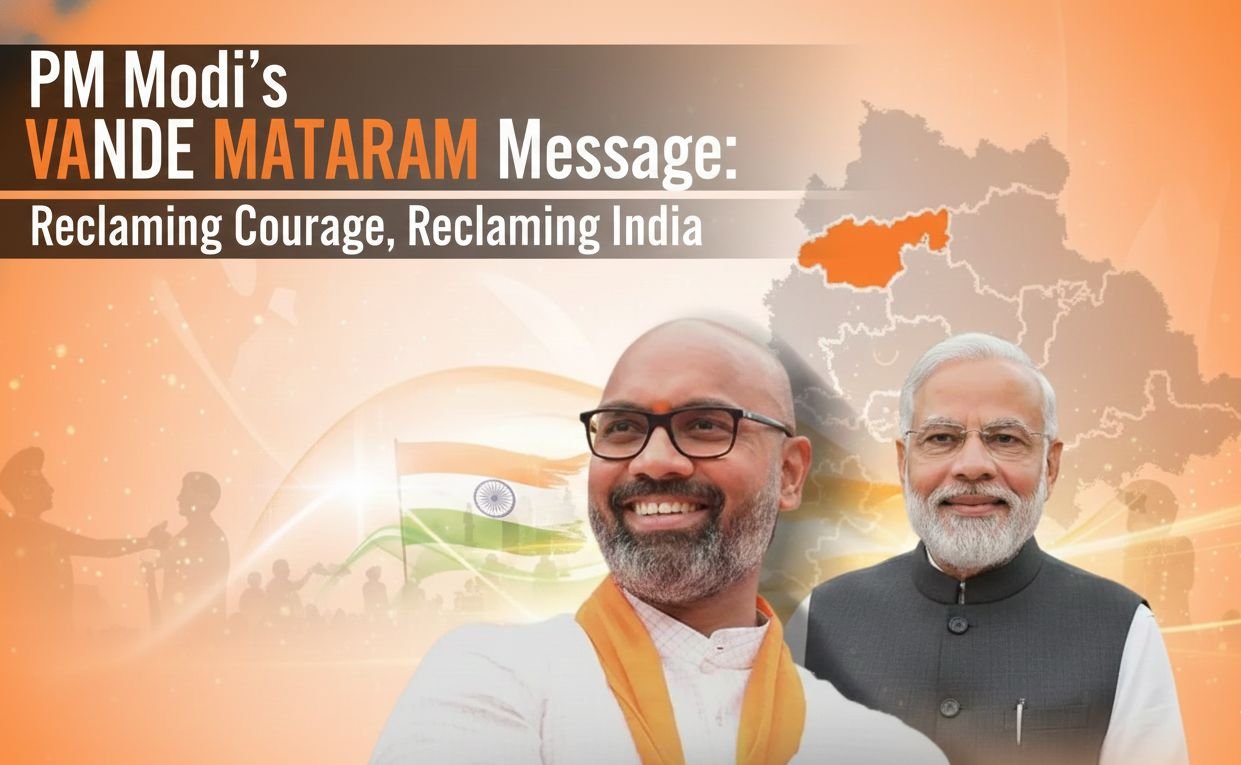
PM Modi’s Vande Mataram message: Reclaiming courage, reclaiming India
When Bankim Chandra Chattopadhyay first set down the lines that would become Vande Mataram in the 1870s, he was not merely composing a lyric. He was answering an imperial project that sought, in many ways, to remould Indian public life and loyalties. As Prime Minister Narendra Modi reminded Parliament during the 150th anniversary debate, the poem emerged at a time when, in the wake of 1857, British authorities were determined to cement symbols of imperial loyalty in Indian households—most prominently the British anthem “God Save the Queen.” Bankim’s hymn, Modi said, was “a strong and befitting reply” to that cultural pressure, and in the decades that followed, it became one of the clearest rallying cries of Indian nationalism.
A poem born in a storm
Scholars generally place the composition of the lines that would form Vande Mataram in the mid-to-late 1870s; the text was later incorporated into Bankim’s novel Anandamath (published in 1882). In its original Sanskritised Bengali, the poem personified the land as a mother and combined devotional diction with a martial urgency—an idiom that proved instantly resonant in an India still reeling from the memory of the 1857 uprising.
The British response was predictably uneasy: the text and the novel were periodically censored, and its public recitation was criminalised at various times during colonial rule. The result was that when people sang it together—on the streets of Calcutta, in Congress halls, at public meetings—the act itself became a defiant assertion of political identity.
1937 Vande Mataram Controversy and Congress Compromise
However, the radical elements of that time did not like the whole song and questioned the presence of Goddess Durga in the hymn. In 1937, the formation of Congress ministries in several provinces led to the active promotion of Vande Mataram in educational institutions as a symbol of nationalist emotion. This move, however, generated objections from Muslim leaders, who argued that some of the later stanzas of the song contained explicitly Hindu religious imagery and symbolism. They also expressed concern that making the song compulsory in schools could violate the principle of religious freedom in a plural society.
Responding to these concerns, the Congress Working Committee intervened in 1937 to find a conciliatory solution. The CWC compromised that only the first two stanzas of Vande Mataram, which are purely patriotic in content and free from religious references, should be sung or used officially. The remaining stanzas would not be made compulsory, reflecting the Congress leadership’s attempt to promote secular sentiment by restricting the song to the second stanza.
From the banks of the Hooghly to the subcontinent
Although the poem originated in Bengal, its emotional vocabulary—motherland as sacred, freedom as both moral and civic duty—spread swiftly across regions. By the early 20th century, the chant had transcended language zones: it was sung at mass meetings in Bengal, recited in the Hindi heartland, and taken up by revolutionaries abroad and by Congress leaders at national sessions.
The anti-partition agitation in Bengal (1905) and subsequent Swadeshi movements helped amplify it as a unifying slogan, one shouted at rallies that cut across class and regional lines. Newspapers of the period and later historical accounts document how the song circulated through print, pamphlets, and public performance, becoming part of a shared political repertoire that mobilised people from port towns to rural hamlets.
Colonial anxiety and cultural counters
The British authorities did not just fear the poem’s words; they feared its capacity to assemble people. Efforts to suppress Vande Mataram—through fines, bans, and police action—only heightened its symbolic potency. As later nationalist leaders observed and historians recorded, the hymn worked precisely because it converted private affection for the land into public political solidarity. In other words, it transformed devotional language into civic action—a shift the colonial state found hard to police without revealing its own political weakness.
Post-Independence status and contestations
When India’s Constituent Assembly took up the question of national symbols, Vande Mataram was given formal recognition: the first two stanzas were designated the national song, placed alongside the national anthem in ceremonial esteem.
In the Lok Sabha debate marking 150 years of Vande Mataram, Prime Minister Modi framed the song’s story as a national reclamation. He argued that Bankim “gave India a hymn that challenged colonial arrogance” at a time when Britain was promoting its anthem in India, and used that historical frame to critique past political choices—most notably pointing to Jawaharlal Nehru and the Congress with the charge that they “bowed” to political pressures and thereby allowed the song’s legacy to be sidelined. Modi’s speech deliberately linked the poem’s 19th-century potency to present-day projects of cultural renewal.
These comments sparked immediate debate in Parliament and the press, with opposition leaders calling it a politicisation of history while supporters praised the attempt to reassert national symbols.
From colonial reply to contemporary revival: Atmanirbhar Bharat and cultural policy
Modi’s invocation of Vande Mataram sits comfortably within a broader policy narrative his government has advanced—what is often called Atmanirbhar Bharat (self-reliant India). Alongside economic and industrial initiatives, the administration has pursued cultural projects: promoting Sanskrit education, establishing institutions and grant programmes to digitise and preserve manuscripts, and supporting public campaigns around indigenous knowledge and heritage.
Government public information releases and media coverage make clear that this is not just nostalgic rhetoric but a set of concrete institutional moves—central universities, schemes for teaching Sanskrit, and digital conservation projects—that together aim to revive and repurpose classical cultural resources for the present. For supporters, this is restorative; for critics, it risks reading contemporary policy through a historicist civilisational lens that can marginalise alternative perspectives.
How history travels across politics
What Vande Mataram’s 150th anniversary makes visible is how historical texts are continually reinterpreted to serve political purposes. For some, the hymn is proof that India’s civilisational self-esteem can be rekindled and made the basis for public solidarity. For others, the hymn’s selective use—focusing on certain stanzas, certain historical readings, certain heroes—risks flattening a more complicated past in which figures, movements, and communities negotiated identity in layered ways. The parliamentary sparring over Nehru and Bankim is therefore not only about personalities; it is about whether the past is a terrain for healing and inclusion, or a battleground for contemporary dominance.
An invitation, not a mandate
If history teaches anything about Vande Mataram, it is that songs are instruments of invitation: they invite people to imagine themselves as part of something larger. The most enduring national symbols are those that invite rather than coerce, that preserve complexity rather than collapse it. Celebrating Bankim’s lines on their 150th birthday is an opportunity to recall how a phrase—born as a reply to imperial cultural imposition—became a chorus of resistance. But celebration should also be a moment for honest reflection about who feels included in that chorus today, and how a democratic polity can preserve patriotic sentiment while protecting pluralism.
A song that still asks a question!
Bankim’s Vande Mataram began as a lyrical answer to a colonial anthem. Over a century and a half, it has moved from novel to rallying cry, from banned text to constitutional recognition, and now into parliamentary commemoration and contemporary cultural policy. Prime Minister Modi’s reminder that the poem answered “God Save the Queen” is historically grounded and rhetorically potent; the real question for India today is not which side of history one stands on, but how history is used to build an inclusive future. If Vande Mataram still resonates, let it be because it helps summon bravery and belonging for all Indians—north and south, east and west—without closing the door on difference.
– Authored by the Office of AD