
Born in Gwalior on a cold winter morning in 1924, a child arrived who would one day connect the dreams of a billion Indians—from the snow-capped peaks to the golden shores. Atal Bihari Vajpayee was more than a statesman; he was a nation-builder who believed that India’s strength lay in its unity, progress, and the indomitable spirit of its people.
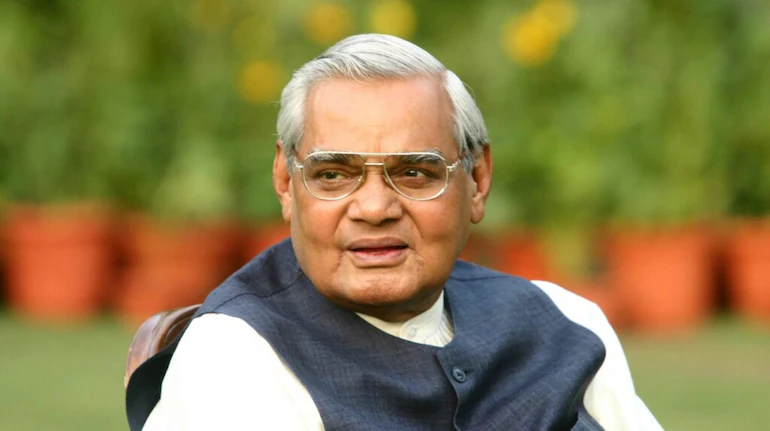
File Photo: Atal_Bihari_Vajpayee
Connecting a Nation: The Golden Quadrilateral
It was an ambitious dream, many thought, when Atal Ji envisioned the Golden Quadrilateral Project. For him, it was quite literally the road to a united and progressive India. The highways connecting Delhi, Mumbai, Chennai, and Kolkata did more than bridge distances; they connected hearts, aspirations, and opportunities.
For the first time, India’s north touched the south, and the east met the west through a seamless web of roads that carried not only vehicles but also the pulse of a growing nation. Today, as Narendra Modi’s government expands expressways, builds coastal roads, and integrates the Bharatmala and Sagarmala projects, it is the same vision of connectivity that Atal Ji once imagined.
Architect of Modern Governance
Governance, as envisioned by Atal Ji, rested on three core principles: simplicity, transparency, and a people-first approach. Landmark initiatives, such as the Sarva Shiksha Abhiyan, Pradhan Mantri Gram Sadak Yojana, and the telecom revolution, have reshaped India’s developmental journey. He was among the first leaders recognise that true progress begins when the last person in the queue is empowered.
As the present government strengthens the digital ecosystem through Digital India, electrifies every village under Saubhagya Yojana, and enhances rural connectivity via PM Gram Sadak Yojana 2.0, the echoes of Atal Ji’s governance blueprint continue to resonate.
Laying the Foundation of Viksit Bharat
The idea of Viksit Bharat is deeply rooted in Atal Ji’s conviction—an India that is confident, self-reliant, and globally respected. His policies in infrastructure, education, foreign affairs, and technology laid the foundation for modern India.
He sowed the early seeds of Atmanirbhar Bharat by encouraging innovation and entrepreneurship while firmly safeguarding national interests. The Pokhran-II nuclear tests stood as a bold assertion of India’s sovereignty, announcing to the world that Bharat would stand tall on its own terms.
From Atal’s Vision to Modi’s Mission
Two decades later, the torch of progress has been carried forward with determination and scale. Initiatives such as Gati Shakti Yojana, Make in India, Startup India, and Vande Bharat Trains reflect the continued spirit of Atal Ji’s developmental nationalism.
Just as Atal Ji connected cities with roads, today’s leadership connects aspirations through digital and logistical highways. Rural broadband, bullet trains, smart cities, and a fully electrified railway network show how foundations laid with bricks and tar have evolved into fibre optics and rails of the future.
Marching Towards Vishwaguru Bharat
Atal Ji firmly believed that India’s identity was not merely that of a developing nation, but of a Vishwaguru—a guiding light to the world. His foreign policy was defined by dignity, peace, and strategic strength.
Today, India plays a leadership role in global forums, contributes meaningfully to climate initiatives, and sends missions to the Moon and beyond. This global stature is a continuation of the confidence and credibility Atal Ji envisioned for Bharat.
The highways bustling with activity, schools educating tens of millions, and digital networks reaching deep into rural India all bear the imprint of Atal Ji’s vision. His dream of a stronger, more united, and progressively advancing Bharat continues to expand as Viksit Bharat takes shape.
Atal Ji did not merely build roads and policies—he built confidence. That confidence, now amplified and energised, propels India toward its rightful destiny as Vishwaguru Bharat.