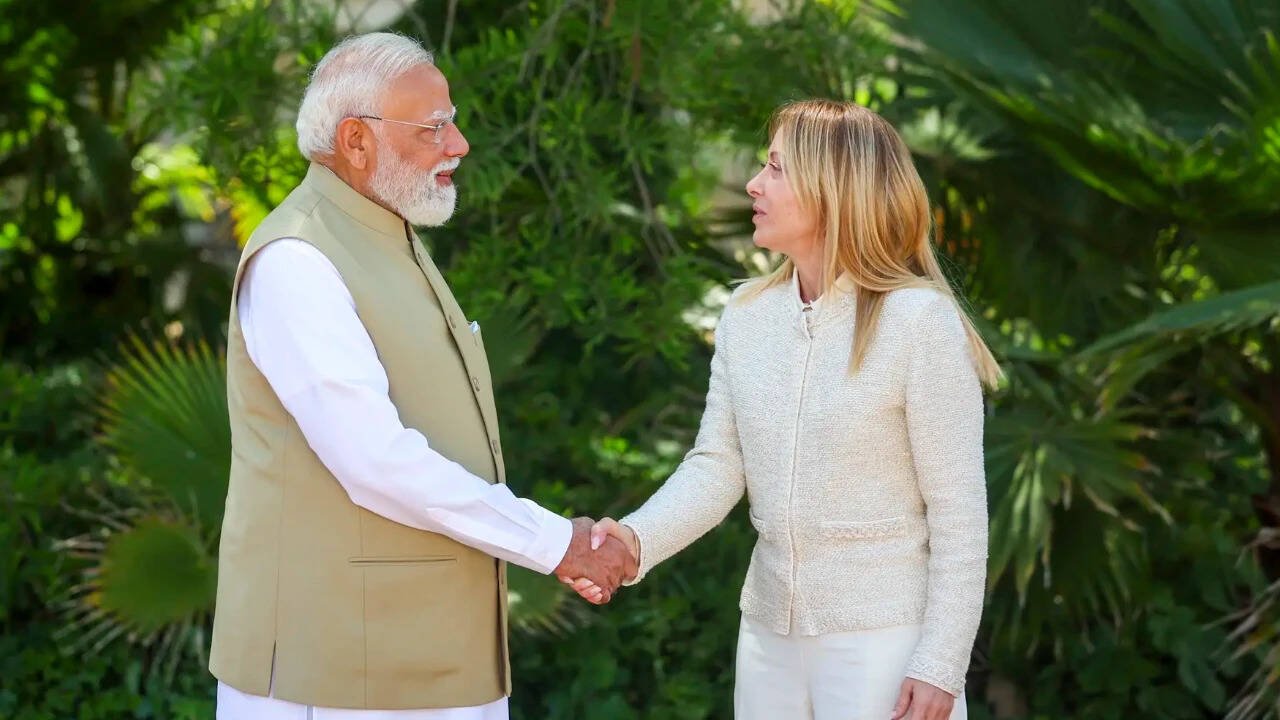
PM Modi’s recent visit to Italy received strong public attention, especially around his warm interaction with Italian Prime Minister Giorgia Meloni.
The “Melody” moment quickly went viral on social media, and people started making memes and jokes around it. However, behind those smiling photographs stood a serious strategic message that many observers missed.
The India-Italy partnership today is no longer limited to diplomatic meetings or trade discussions. It has now become part of a much larger geopolitical and economic strategy that connects Europe, the Middle East, and India through the ambitious India-Middle East-Europe Economic Corridor (IMEC).
This visit showed how India is building long-term partnerships to protect its economic interests, strengthen global supply chains, and reduce dependence on China-centric trade networks.
IMEC Is the Real Strategic Story Behind PM Modi’s Italy Visit
The biggest outcome connected to the India-Italy partnership is the growing push behind IMEC. The corridor aims to connect India with Europe through ports, rail networks, energy links, and digital infrastructure passing through the Middle East.
For India, IMEC is not just another trade route. It is a strategic alternative to China’s Belt and Road Initiative (BRI). For years, China expanded its economic and political influence by investing heavily in ports, transport systems, and infrastructure projects across Asia, Africa, and Europe. Many countries became dependent on Chinese manufacturing and supply chains.
India now wants a different model.
IMEC can help Indian goods reach European markets faster and more efficiently. It can reduce shipping time, improve energy cooperation, and create new opportunities for Indian businesses. At the same time, Europe also wants to reduce overdependence on Chinese supply chains after recent global disruptions exposed the risks of relying too heavily on one country.
Italy becomes important in IMEC because of its location and influence inside Europe. Italy is not just a major European economy with strong manufacturing capabilities but also possesses strategically important ports. As a result, it can serve as a key gateway for Indian trade entering European markets.
India-Italy Strategic Partnership Goes Beyond Trade
During the visit, India and Italy expanded cooperation in defence, space, clean energy, technology, and critical infrastructure. To tackle future economic and security competition, such cooperation has become increasingly important for both nations.
India understands that modern global competition is no longer fought only on battlefields. It now includes technology leadership, semiconductor supply chains, energy security, artificial intelligence, and maritime connectivity.
Italy also sees India as a stable and fast-growing partner in Asia. Both countries share concerns about supply chain vulnerabilities and rising geopolitical tensions. This demonstrates a partnership that goes beyond traditional diplomacy and reflects a long-term strategic vision.
Defence cooperation between the two countries can not only improve maritime security but is also important for securing critical sea routes. Technology partnerships will support innovation and manufacturing, while energy cooperation will help both countries move toward cleaner and more secure energy systems.
Together, these partnerships will support India’s larger goal of becoming a trusted global manufacturing and economic hub.
Diplomacy in the Digital Era: More Than a Viral ‘Melody’ Moment
The public conversation around the PM Modi -Meloni interaction also highlights a larger reality about modern diplomacy. In today’s world, leadership chemistry and public communication matter alongside official agreements.
Strong partnerships are easier to build when leaders establish trust and comfort with each other. Public diplomacy now plays an important role in shaping global perception, investor confidence, and international cooperation.
Many critics focused only on viral moments and social media trends. But international diplomacy often works through personal trust built over repeated interactions between leaders.
The images may look informal, but the outcomes remain serious and strategic.
PM Modi’s Italy Visit Fits India’s Long-Term Global Strategy
PM Modi’s Italy visit fits into India’s broader foreign policy direction. India wants stronger partnerships with Europe, the Middle East, and other democratic economies while maintaining its strategic independence.
The government understands that future economic power will depend on resilient supply chains, secure trade routes, and trusted international partnerships. IMEC represents that vision.
The corridor can help India increase exports, attract investment, and strengthen its position in the global economy. At the same time, it sends a message that many countries are now seeking alternatives to heavily China-centric economic systems.
This is why the Italy visit mattered far beyond headlines, hashtags, or viral clips. It was part of a larger effort to shape a new economic and strategic architecture connecting India to the world on its own terms.