India celebrated its 77th Republic Day on January 26, 2026, with a magnificent display of military power and diplomatic skill. Through coordinated demonstrations of cutting-edge weaponry and operational synergy, the Indian Army, Navy, and Air Force showcased unmatched valour (jauhar).
While New Delhi steadfastly pursued its strategic interests amid U.S. tariff pressures and maintained balanced ties with Russia and Europe, India’s diplomacy shone brightly as European Union leaders attended as chief guests for the first time. Republic Day 2026 became a defining moment in India’s rising global influence and strategic autonomy.
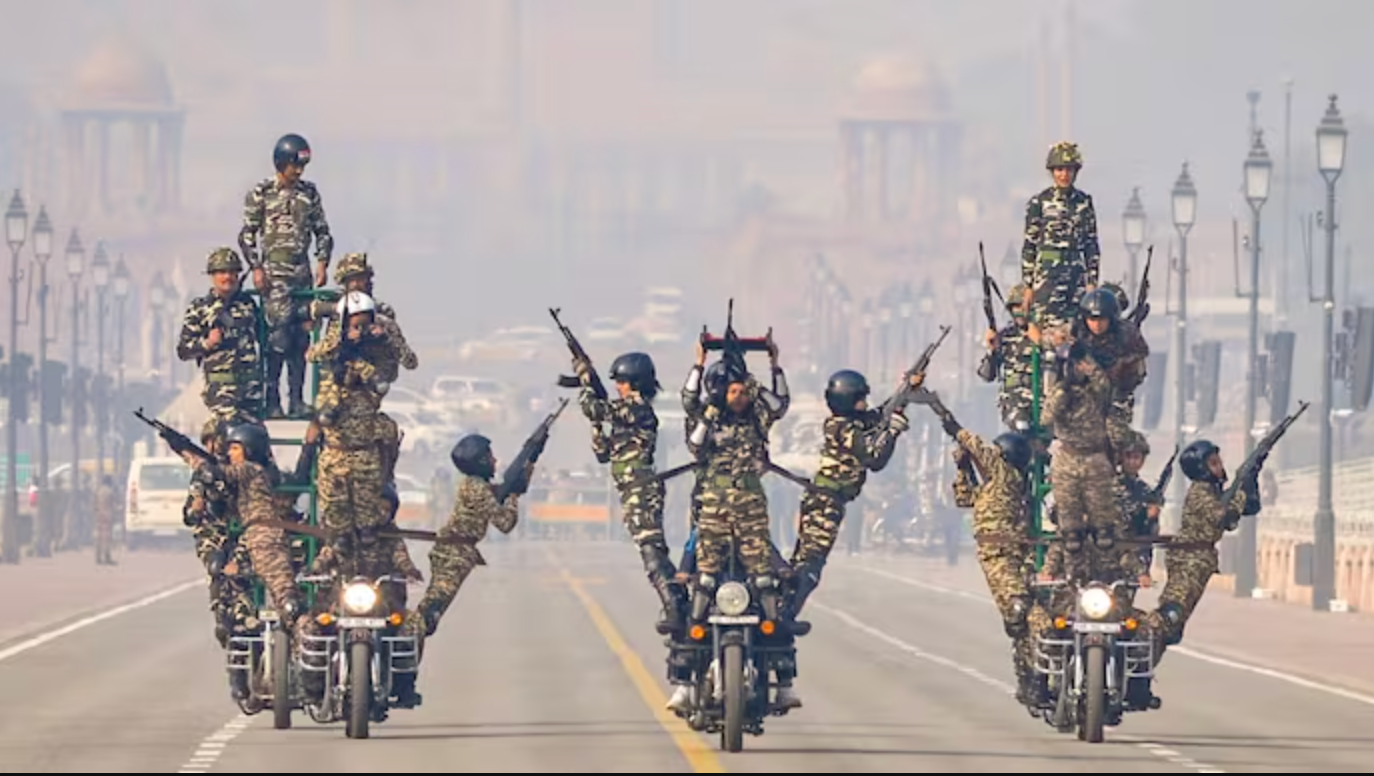
The Tri-Services Display: Valour on Full Display
India’s three senas were seamlessly integrated, as demonstrated by the Republic Day parade at Kartavya Path in New Delhi. Platforms like Rafale fighter jets soaring overhead for air superiority and the BrahMos supersonic missile system—developed in collaboration with Russia—showcased precision strike capabilities.
A tri-services tableau effectively demonstrated modern warfare coordination. Tableaux referenced recent operations such as “Operation Sindoor,” highlighting combat readiness and innovation.
These components projected national pride, deterrence capability, and unity to both domestic and international audiences by emphasising the military’s rigorous training and operational experience. The Republic Day parade 2026 reinforced India’s growing defence capabilities and modernisation efforts.
Historic EU Participation: First-Time Chief Guests
For the first time, the European Union participated collectively in India’s Republic Day celebrations. Ursula von der Leyen, President of the European Commission, and António Costa, President of the European Council, joined President Droupadi Murmu and Prime Minister Narendra Modi as chief guests.
Their presence symbolised the strategic elevation of India–EU relations, founded on shared democratic values and economic interests. According to von der Leyen, it was an “honour of a lifetime,” and she stated that “a successful India makes the world more stable, prosperous, and secure.”
The invitation marked years of diplomatic preparation and underscored India’s growing prominence on the global stage.
The Landmark India–EU Trade Deal: Defying External Pressure
Just one day after the parade, on January 27, 2026, India and the EU announced the conclusion of negotiations on a comprehensive Free Trade Agreement (FTA), described as the “mother of all deals.”
After nearly two decades of intermittent talks, the India–EU FTA promises to transform bilateral economic relations. Key provisions include the EU eliminating or reducing tariffs on 96.6% of its exports to India, while India grants preferential access for EU goods such as automobiles, wines, spirits, and agricultural products under defined quotas.
Indian exporters gain unprecedented market access for textiles, leather, marine products, gems, jewellery, and more, with zero or reduced duties on over 99% of trade value.
The agreement creates a combined market of nearly two billion people, representing about a quarter of global GDP. It aims to boost supply chain resilience, attract investment, strengthen MSMEs, and accelerate green energy cooperation. Officials described it as the largest trade deal for both sides, balancing the protection of sensitive sectors with expanded global trade opportunities.
Navigating U.S. Tariff Pressures: Refusing to Bow
The India–EU FTA unfolded against intense U.S. pressure under President Donald Trump. His administration imposed additional tariffs on Indian goods totalling up to 50%, including a 25% component linked to India’s purchases of Russian oil amid the Russia–Ukraine conflict.
These measures aimed to influence India’s energy ties with Moscow, with threats of even higher duties—up to 500% proposed in related legislation. U.S. Treasury Secretary Scott Bessent highlighted the tariffs’ impact, citing reductions in Indian and Russian oil imports as a “success.” He suggested potential relief for the 25% Russia-linked portion if reductions continued, whilecriticisingg Europe for indirectly supporting Russia by purchasing refined products from India.
India, however, refused to yield to coercive tactics. Instead, it accelerated economic diversification through the EU partnership, reducing reliance on any single market and reinforcing supply chain stability.
Strategic Autonomy: Balancing Russia and Europe
India’s approach exemplifies strategic autonomy and multi-alignment. It maintained longstanding defence and energy ties with Russia, evident in systems like BrahMos, while pragmatically scaling back Russian oil imports to mitigate U.S. tariff risks.
Simultaneously, deeper economic integration with the European Union provided a counterbalance. This balanced diplomacy—engaging multiple global powers without exclusive dependence—demonstrates India’s maturity in an increasingly multipolar world.
India’s Evolving Global Role
Republic Day 2026 encapsulated India’s dual strength: the “jauhar” of its armed forces, inspiring national confidence and diplomatic finess,e securing strategic gains. Under Prime Minister Modi’s leadership, India demonstrated that it listens to the world but decides on its own terms—refusing to bow to pressure, embracing partnerships on equitable grounds, and charting an independent strategic path.
In an era of geopolitical realignment, this blend of military prowess, economic strategy, and diplomatic agility positions India as a decisive, sovereign power shaping the global order.